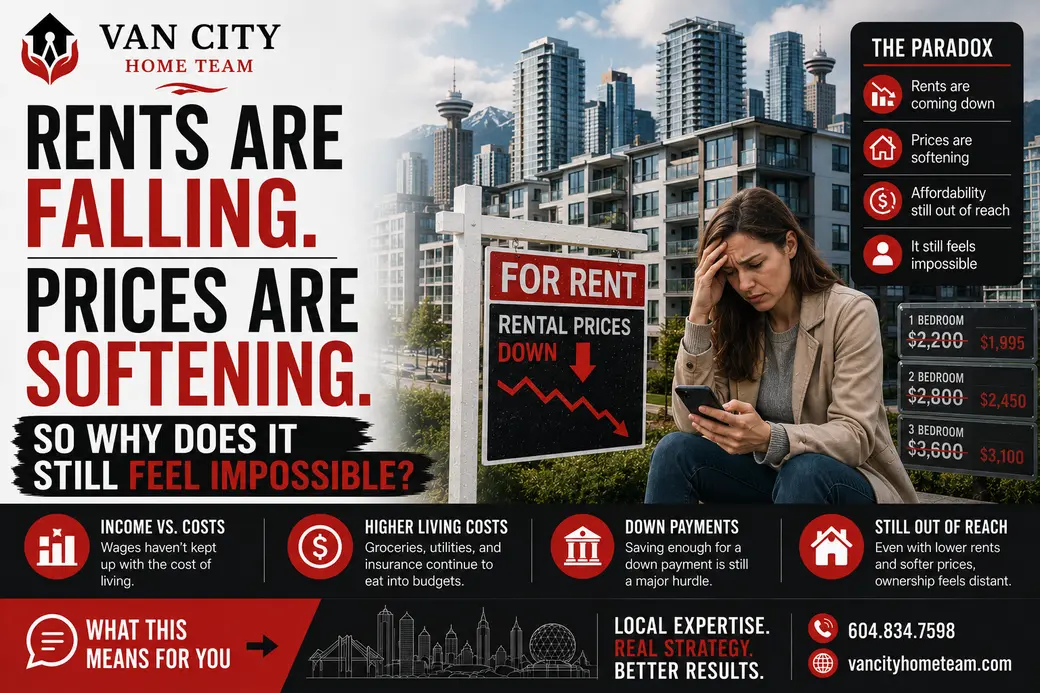
Asking rents in British Columbia continue to fall, sliding by 4.5 per cent year over year in July, according to a new report.
The latest monthly analysis from Rentals.ca and Urbanation, which is based on asking rents across the former's listings network, pegged the provincial average for all property types at $2,384.
Asking rents for purpose-built and condo apartments showed a more moderate 4.1 per cent dip year-over-year to $2,357 — ranging from $2,080 for a one bedroom to $3,265 for a three bedroom.
That makes B.C. the second most expensive market in Canada, behind Nova Scotia, according to the report.
In Vancouver, average rent for apartments and condos was down 4.5 per cent from last year, to $2,677, and down nearly 20 per cent from its peak in August 2023.
North Vancouver remained the most expensive rental market in Canada, with an average asking rent of $3,019 for purpose-built and condo apartments. Richmond ($2,537), Burnaby ($2,535) and Coquitlam ($2,492) were all in the top ten.
Five of the Canadian cities with the biggest year-over-year drops in asking rent for purpose-built rentals were in B.C.: Abbotsford (-12.4 per cent), Langley (-7.6 per cent), Coquitlam (-7.3 per cent), New Westminster (-6.6 per cent) and Richmond (-6.1 per cent).
What's behind the drops?
B.C. Housing Minister Christine Boyle said it was the 25th consecutive month of falling rents, which she attributed to the government's housing efforts.
"We, as a government, have gone after speculators to make sure that homes aren't sitting empty, that homes are for people to live in," she told CBC's The Early Edition.
"That's made a difference through the speculation and vacancy tax, through restrictions and regulations on short-term rental that has made thousands more long-term rental homes available to people who live and work in communities around the province."
Boyle also touted provincial legislation to allow more density, including townhouses and mulitplexes, particularly in areas near transit as making a "big difference."
Brendon Ogmundson, chief economist with the B.C. Real Estate Association, said the province does deserve credit for work to increase supply, lower development costs and address zoning challenges.
But he said provincial policy was far from the only factor affecting rents.
"It's immigration policy, it's federal policy really incentivizing purpose-built rental," he said.
"And, it's frankly weakness in the condo sector causing a lot of developers to have to pivot to building purpose-built rental."
Regardless of the cause, the decreases have created a more competitive market for renters.
Landlord B.C. CEO David Hutniak said finding new tenants can be expensive for landlords, meaning they'll want to try and keep good tenants if they have them already.
"Try to find a middle ground there to keep those folks, you’re going to be faced with matching some of the rents, or at least the incentives that are out in the market," he said.
"It’s a more competitive environment, that’s what it boils down to."
Despite the decreases, Boyle acknowledged renting in B.C. is still expensive compared to other provinces, and said the government still has "a huge amount of work to do."
The report pegged the national average asking rent across Canada at $2,037 for July, a drop of 7.5 per cent in the last two years.